Growing pains aren't random. They leave signals.
Bring the messy operating pressure: stalled decision, AI rollout, reorg drag, customer friction.
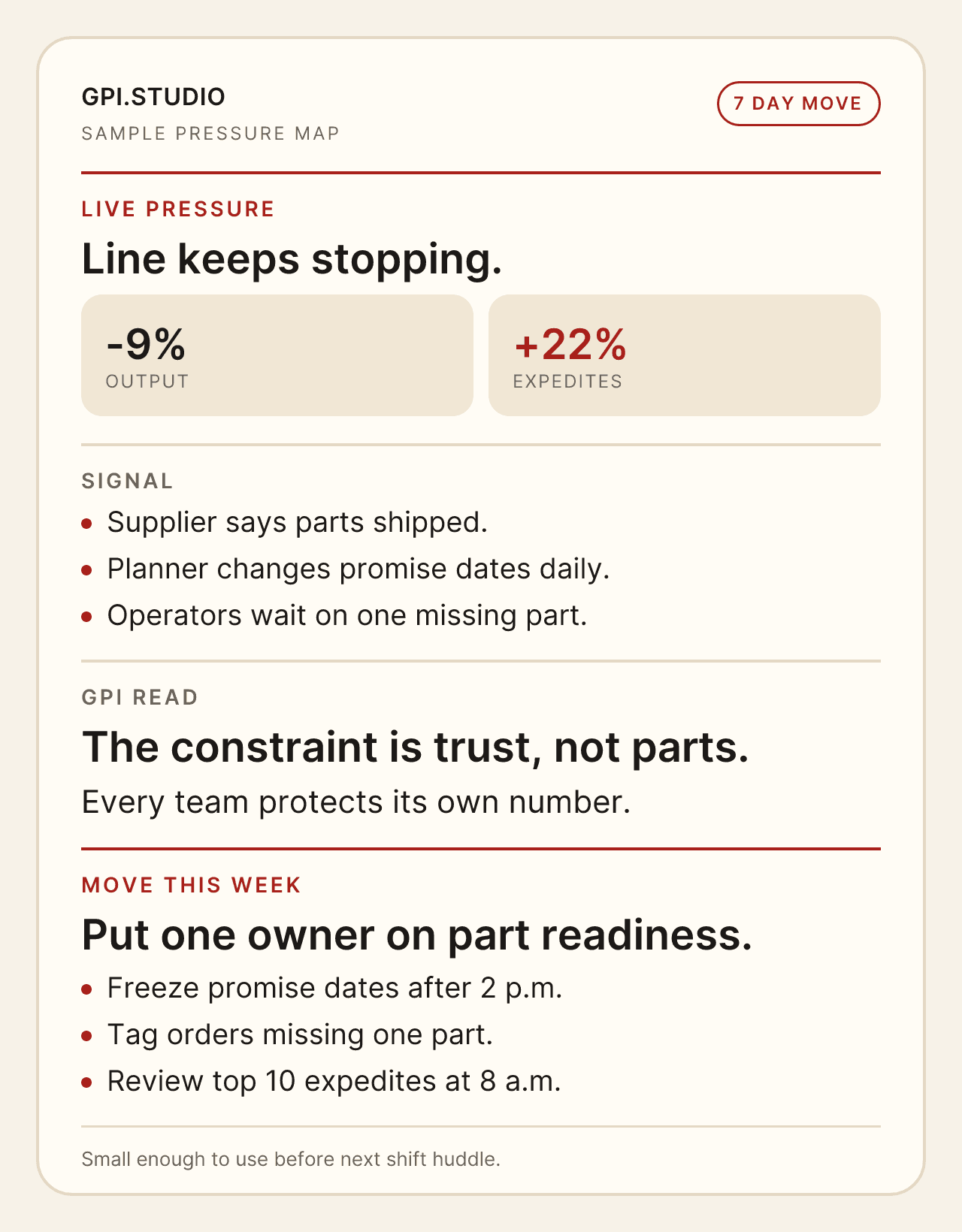
GPI Studio breaks down the tape and turns the read into a move small enough to use this week.
Your team wants the speed, but the first real question is permission. Who lets the agent touch the work, who owns the miss, and which tasks are too expensive to break?
Finance will ask what the agent changed, who approved it, and why the answer moved. If the trail is missing, trust turns into another meeting.
The studio is where rough signals get worked until they can carry weight.
Every week, the studio studies real companies in motion: layoffs, pricing fights, AI agents, leadership changes, broken acquisitions, strange customer friction, and quiet operating drag.
It works like film. Pause the play. Watch the handoff. Check who had the ball. Look for the moment the system started protecting itself instead of moving the work.
The work has one job: build sharper eyes for the moment your own company starts feeling heavy.
GPI means Growing Pains Index.
Growing pains show up before the obvious failure: a slow decision, a repeated mistake, knowledge trapped in one person, talent boxed out of the hard work, a past bet making the next move expensive.
The index comes from more than 1,100 company reads. The studio uses the evidence pile like game tape, so a client problem gets compared against real patterns instead of one person's hunch.
Lower friction means the company can still learn, move, and correct. Higher friction means the organization may be turning its own weight into a wall.
1,100-plus company reads across public markets, sectors, failures, pivots, and pressure points.
The part of work still hurting after everyone gets smarter and busier.
Seven pressure points: decisions, errors, knowledge, talent, lock-in, capital, and learning speed.
A clearer read, a sharper map, or a next move while there is still space to turn.
Start with the pressure point.
Thirty-two questions turn the broad feeling into a first read: decision drag, error cleanup, trapped knowledge, talent stuck in the wrong place, old commitments, capital weight, or slow learning.
Not the whole answer. Just enough to know which part of the system deserves the first look.
Find the pressure pointBring the pressure. Grind it into a move.
The studio runs like a floor process. The rough thing comes in, gets watched from every angle, gets worked against the GPI lens, and leaves with a move the owner can actually make.
The light at the end is usually smaller than people want at first: one decision moved closer to the work, one hidden tradeoff named, one bad path avoided.
Bring the pressure
The messy issue comes in raw: delay, reorg, AI rollout, customer friction, vendor confusion, stalled decision.
Break down the tape
We pull apart handoffs, incentives, old bets, missing owners, and the places where the work keeps losing speed.
Run the reps
The read gets worked into a map, memo, source packet, stop sign, or next move small enough to use.
Leave with a move
One owner, one decision, one path to test, one bad path to avoid before the week gets away.